Pancakes by the dozen
A pancake recipe uses 2 cups of flour and 3 eggs to make 12 pancakes. How many cups of flour are needed for 2 dozen pancakes?
Asked: how many cups of flour (cups). Is a: Find the missing value in a proportion. Answer: 4 cups of flour.
| Phrase | Value | Counts | Needed? |
|---|---|---|---|
| “2 cups of flour” | 2 cups | flour | yes |
| “3 eggs” | 3 eggs | eggs | no |
| “12 pancakes” | 12 pancakes | pancakes | yes |
| “2 dozen pancakes” | 2 dozen | pancakes wanted | yes |
| Decision | Concept | Correct | Traps → wrong answer |
|---|---|---|---|
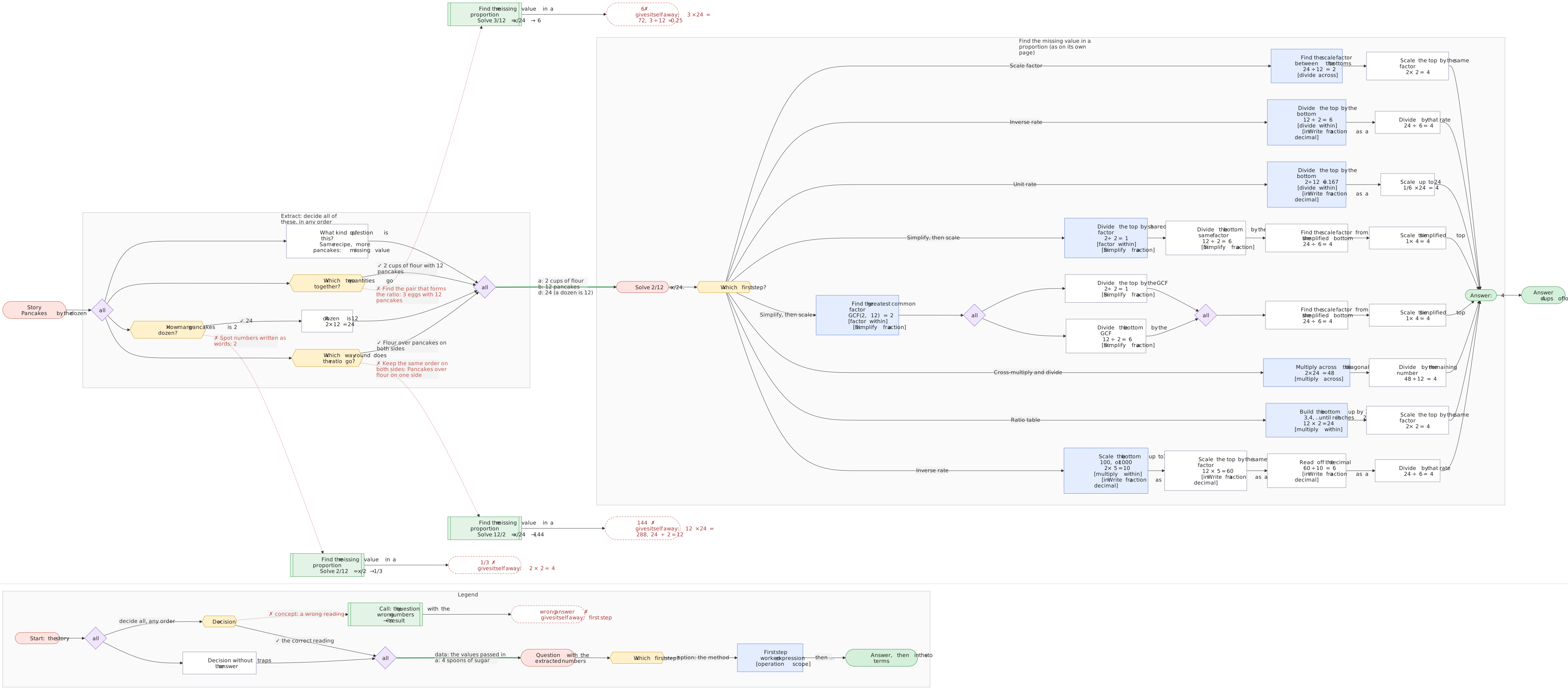
| What kind of question is this? | Recognize the question type | Same recipe, more pancakes: a missing value | — |
| Which two quantities go together? | Find the pair that forms the ratio | 2 cups of flour with 12 pancakes | 3 eggs with 12 pancakes → 6 |
| How many pancakes is 2 dozen? | Spot numbers written as words | 24 | 2 → 1/3 |
| Which way round does the ratio go? | Keep the same order on both sides | Flour over pancakes on both sides | Pancakes over flour on one side → 144 |
The graph starts at the story. The Extract frame holds the decisions; red dashed arrows leave a decision for each trap and run to the wrong answer it produces. The thick green arrow carries the extracted numbers into the question, drawn exactly as on the question’s own page. Any follow-up step comes after, then the answer in the story’s terms. The legend is at the bottom.
| Trap | Mistake | Leads to | Caught by the answer? | Gives itself away with |
|---|---|---|---|---|
| Find the pair that forms the ratio | Scales the eggs instead of the flour. | 6 | yes | 3 × 24 = 72, 3 ÷ 12 = 0.25, 12 ÷ 3 = 4, GCF(3, 12) = 3 |
| Spot numbers written as words | Reads ‘2 dozen’ as 2 pancakes. | 1/3 | yes | 2 × 2 = 4 |
| Keep the same order on both sides | Flips one side: pancakes over flour. | 144 | yes | 12 × 24 = 288, 24 ÷ 2 = 12 |