Find the missing value in a proportion
missing-value · core · prompt: Solve {a}/{b} = x/{d}.
Its methods call: simplify-fraction, to-decimal
| Method | Idea | Best when | Calls |
|---|---|---|---|
Cross-multiply and divide cross_multiply |
{a} × {d} = {b} × x, so x = {a} × {d} ÷ {b}. | Always works; most useful when there’s no whole-number scale factor. | — |
Scale factor scale_factor |
Find what turns {b} into {d}, then do the same to {a}. | {d} is a whole-number multiple of {b}. | — |
Unit rate unit_rate |
Find the value per 1, then scale up to {d}. | {a}/{b} is a friendly decimal. | to-decimal |
Inverse rate inverse_rate |
Find how many of the second quantity per 1 of the first, then divide. | {b}/{a} is a friendly number. | to-decimal |
Ratio table ratio_table |
Build {a}:{b} up by ×2, ×3, … until the second term reaches {d}. | {d} is a small whole-number multiple of {b}. | — |
Simplify, then scale simplify_then_scale |
Reduce {a}/{b} first so a whole-number scale factor appears. | {a}/{b} isn’t in lowest terms. | simplify-fraction |
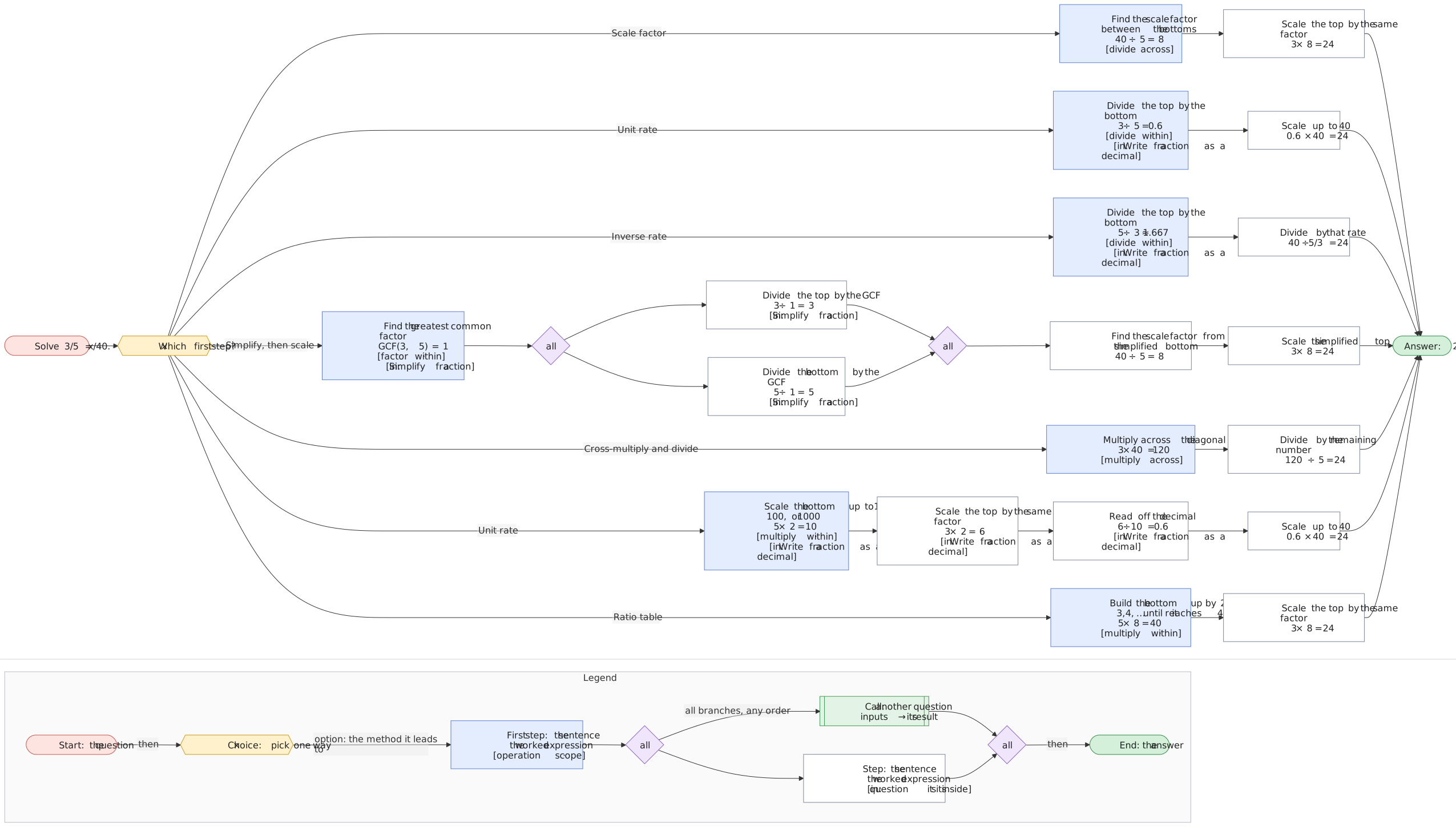
Each graph starts at the question and branches at × Which first step? into every first step a student might write. Methods that share a first step meet there and split at × Which next step?. Each route then follows its method to the answer. The legend at the bottom of each graph explains the shapes.
Solve 3/5 = x/40.
Solve 4/6 = x/15.
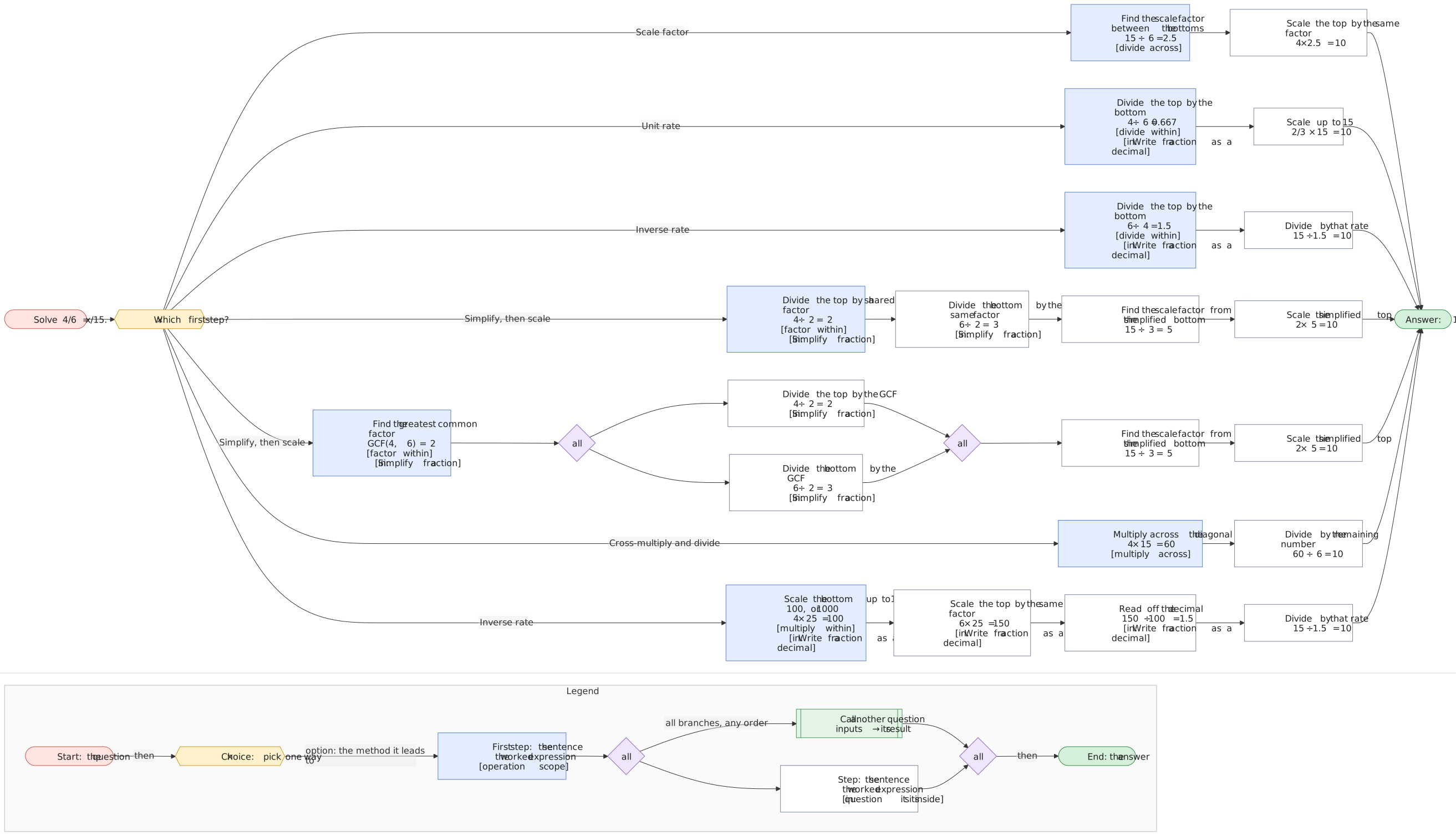
Not applicable here: Ratio table (ratio_table)