Compare two fractions
compare-fractions · core · prompt: Which is larger: {a}/{b} or {c}/{d}? (Or are they equal?)
Its methods call: common-multiple, compare-fractions, cross-products, missing-value, simplify-fraction, to-decimal
| Method | Idea | Best when | Calls |
|---|---|---|---|
Cross-multiply cross_multiply |
{a}/{b} > {c}/{d} exactly when {a}×{d} > {c}×{b}. | A quick check with small numbers. | cross-products |
Common denominator common_denominator |
Rewrite both fractions over the same denominator, then compare numerators. | The denominators are small or related. | common-multiple, missing-value |
Rewrite one fraction over the other’s denominator match_denominator |
Turn {a}/{b} into something over {d}, then compare its top with {c}. | {d} is a multiple of {b}. | missing-value |
Common numerator common_numerator |
With equal numerators, the smaller denominator gives the bigger fraction. | The numerators are smaller or simpler than the denominators. | common-multiple, missing-value |
Convert to decimals decimal |
Write each fraction as a decimal and compare. | A calculator is allowed. | to-decimal |
Compare unit rates (flipped fractions) unit_rate |
How much bottom per 1 of top? The bigger rate belongs to the smaller fraction. | The context is a rate (miles per hour, items per dollar). | to-decimal |
Compare scale factors scale_factor |
How much do the tops grow ({c} ÷ {a}) compared with the bottoms ({d} ÷ {b})? | One fraction looks like a scaled-up version of the other. | — |
Ratio table ratio_table |
Scale {a}:{b} by 2, 3, 4, … until the top reaches {c}, then compare bottoms. | {c} is a small whole-number multiple of {a}. | — |
Graph the points graph |
Plot ({a}, {b}) and ({c}, {d}); the steeper line from the origin belongs to the smaller fraction. | Building intuition. | — |
Simplify both simplify |
Reduce both fractions to lowest terms; equal fractions reduce to the same thing. | Checking equality (proportions). | simplify-fraction |
Distance from 1 distance_from_one |
Find how far each fraction is from 1; the one closer to 1 is bigger. | Both fractions are just below 1 (7/8 vs 9/10). | compare-fractions |
Each graph starts at the question and branches at × Which first step? into every first step a student might write. Methods that share a first step meet there and split at × Which next step?. Each route then follows its method to the answer. The legend at the bottom of each graph explains the shapes.
Which is larger: 3/4 or 5/7? (Or are they equal?)
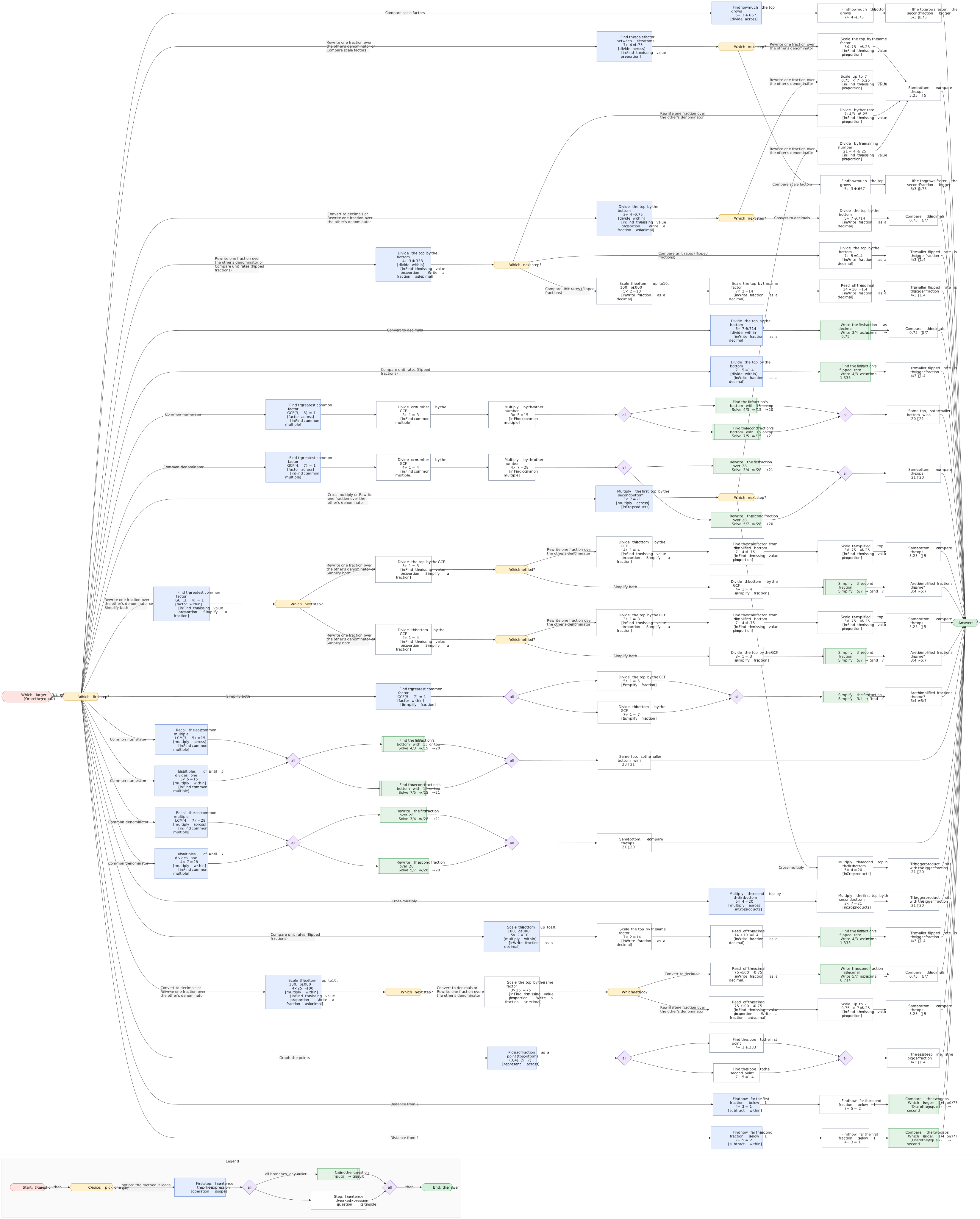
Not applicable here: Ratio table (ratio_table)
Which is larger: 3/8 or 2/5? (Or are they equal?)
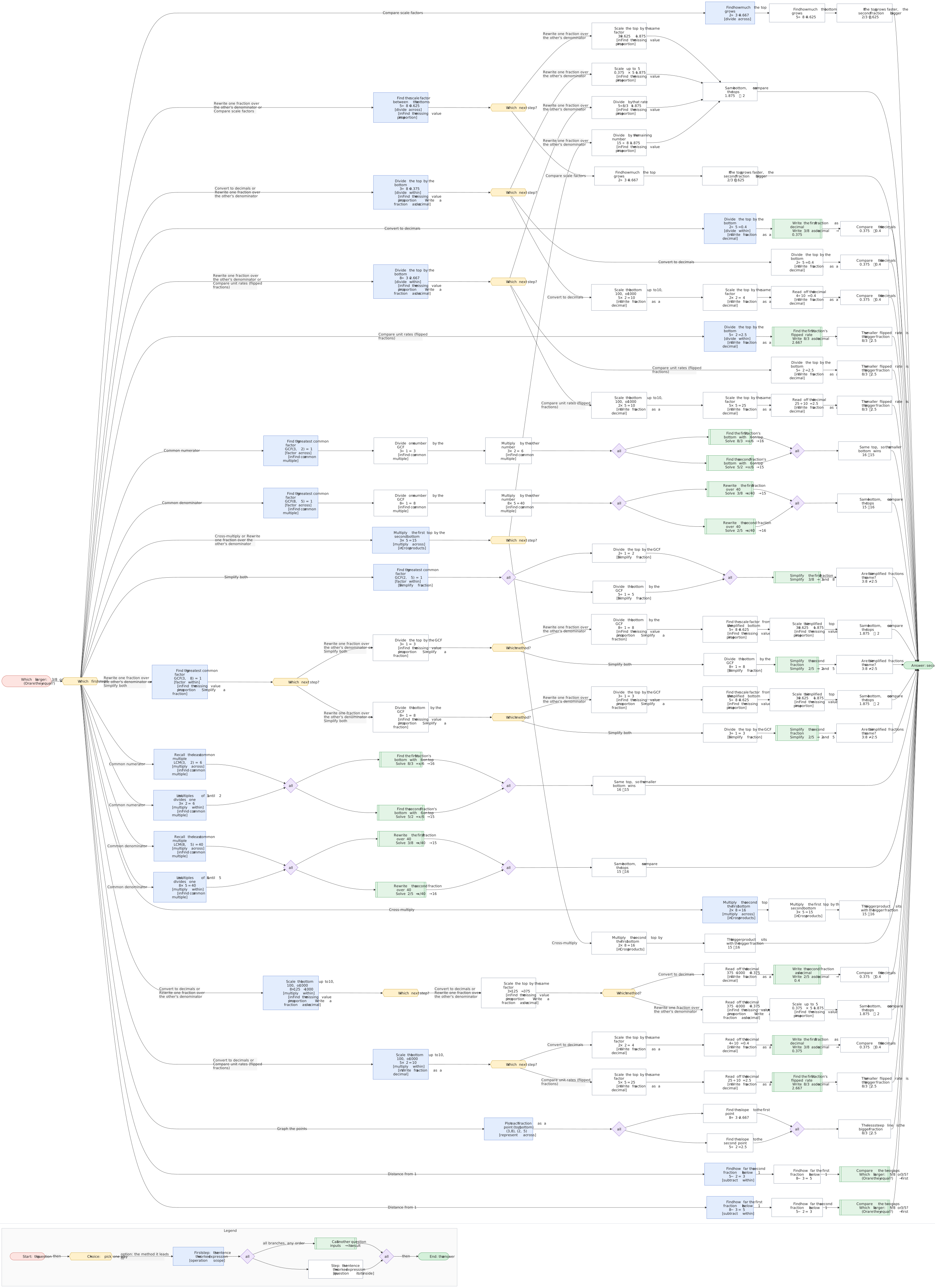
Not applicable here: Ratio table (ratio_table)