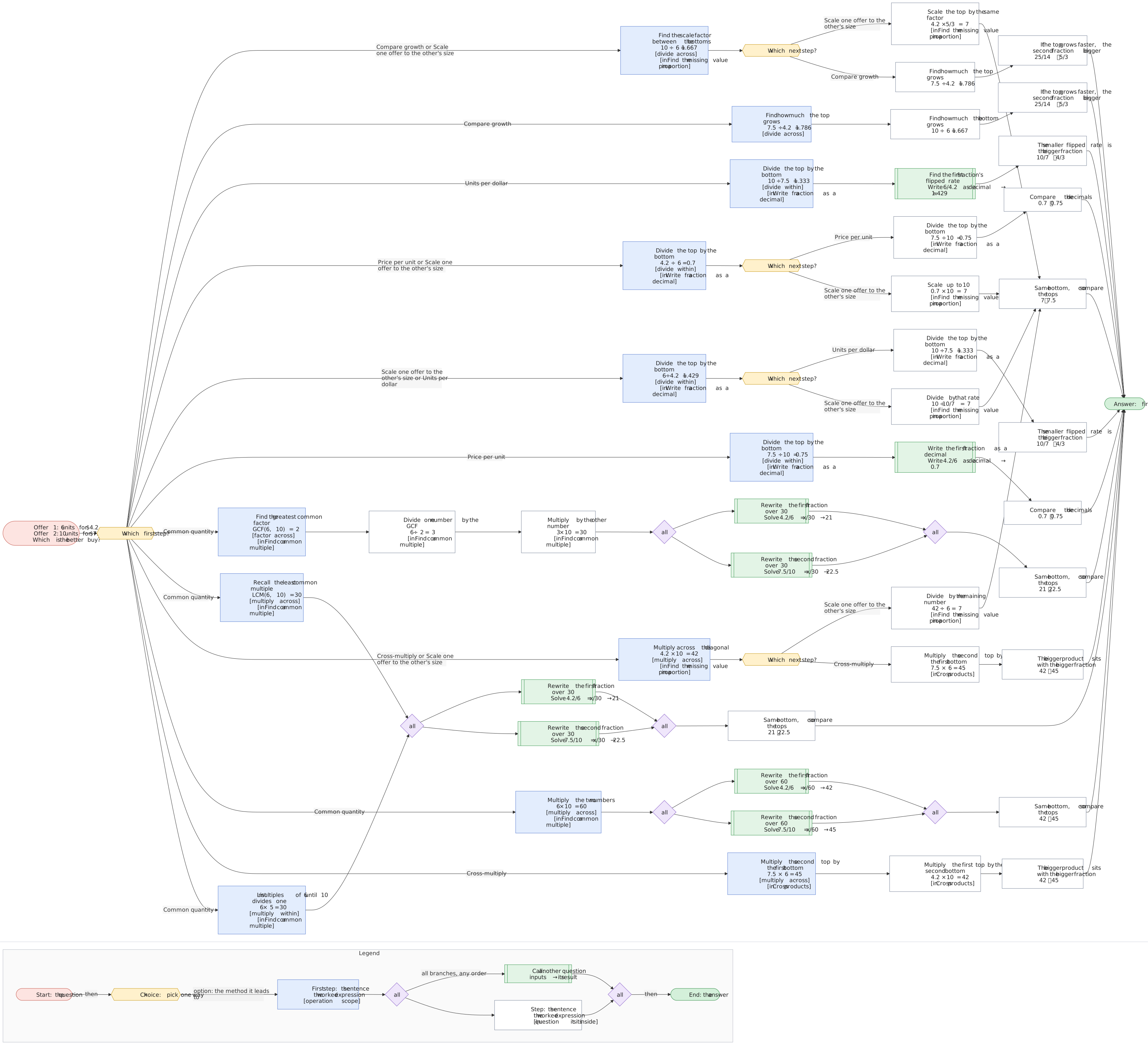
Which is the better buy?
better-buy · applied · prompt: Offer 1: {q1} units for ${p1}. Offer 2: {q2} units for ${p2}. Which is the better buy?
This is compare-fractions in context, with {"a": "p1", "b": "q1", "c": "p2", "d": "q2"}. Compare the prices per unit p1/q1 and p2/q2; the smaller one is the better buy, so ‘first’ (bigger) maps to ‘second’.
| Method | Idea | Best when | Calls |
|---|---|---|---|
Price per unit price_per_unit (= compare-fractions · decimal) |
Find the cost of 1 unit in each offer; lower is better. | A calculator is allowed. | to-decimal |
Units per dollar units_per_dollar (= compare-fractions · unit_rate) |
Find how much $1 buys; more is better. | The context is a rate (miles per hour, items per dollar). | to-decimal |
Common quantity common_quantity (= compare-fractions · common_denominator) |
Price both offers at the same quantity. | The denominators are small or related. | common-multiple, missing-value |
Scale one offer to the other’s size scale_up (= compare-fractions · match_denominator) |
What would offer 1 cost for {q2} units? | {d} is a multiple of {b}. | missing-value |
Cross-multiply cross_multiply (= compare-fractions · cross_multiply) |
{a}/{b} > {c}/{d} exactly when {a}×{d} > {c}×{b}. | A quick check with small numbers. | cross-products |
Compare growth compare_growth (= compare-fractions · scale_factor) |
Price grows by {p2} ÷ {p1}, quantity by {q2} ÷ {q1}; quantity growing faster means offer 2 is better. | One fraction looks like a scaled-up version of the other. | — |
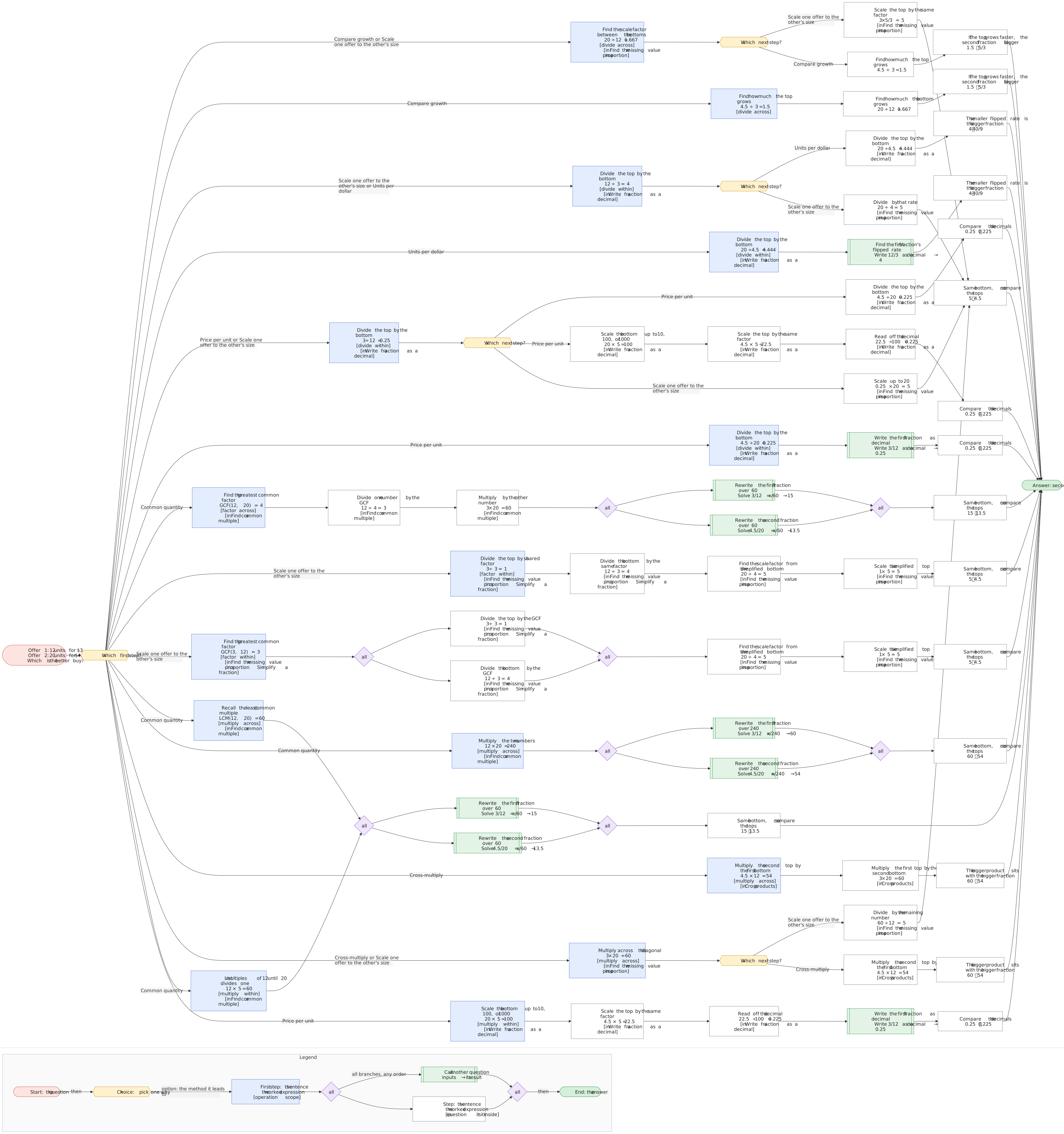
Each graph starts at the question and branches at × Which first step? into every first step a student might write. Methods that share a first step meet there and split at × Which next step?. Each route then follows its method to the answer. The legend at the bottom of each graph explains the shapes.
Offer 1: 12 units for $3. Offer 2: 20 units for $4.5. Which is the better buy?
Offer 1: 6 units for $4.2. Offer 2: 10 units for $7.5. Which is the better buy?