%matplotlib inline
import numpy as np
import scipy as sp
import matplotlib.pyplot as plt
import pandas as pd
pd.set_option('display.width', 500)
pd.set_option('display.max_columns', 100)
pd.set_option('display.notebook_repr_html', True)
import seaborn as sns
sns.set_style("whitegrid")
sns.set_context("poster")
Convexity and Jensen’s Inequality
Why the average of a function isn’t the function of the average.
probability
statistics
Introduces convex functions and proves Jensen’s inequality. Shows how convexity underpins key results in information theory and probabilistic modeling.
Convexity
Let \(f\) be a function with domain the set of real numbers. If the second derivative is greater than zero for all \(x\in R\) this function is convex.
Consider the case of two random variables \(x_1\) and \(x_2\), as seen in the diagram below:
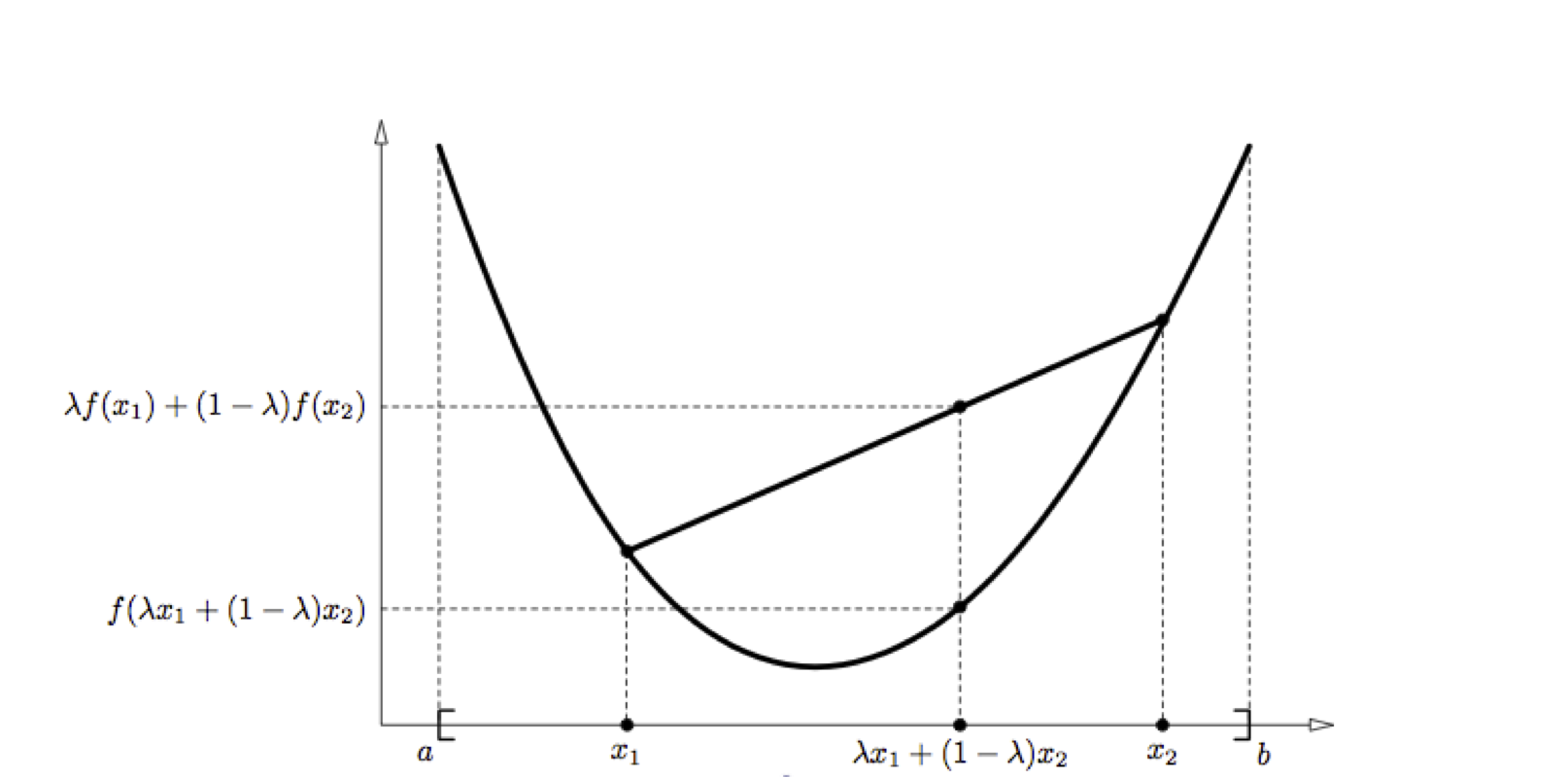
Defnition Let f be a real valued function defined on an interval \(I = [a, b]\). \(f\) is said to be convex on I if \(\forall x_1, x_2 \in I, \lambda \in [0, 1]\),
\[\begin{equation} f(\lambda x_1 + (1 - \lambda)\,x_2) \le \lambda f(x_1) + (1- \lambda)\,f(x_2). \end{equation}\]
\(f\) is said to be strictly convex if the inequality is strict. Intuitively, this definition states that the function falls below the straight line (the secant) from points \((x_1, f(x_1))\) to \((x_2, f(x_2))\). In other words, the equality is satisfied only for \(\lambda = 0\) and \(\lambda = 1\).
Jensen’s Inequality
Let \(f\) be a convex function defined on an interval \(I\). If \(x_1,x_2,\dots,x_n \in I {\rm and} \lambda_1, \lambda_2,\ldots,\lambda_n \ge 0\) with \(\sum^n_{i=1} \lambda_i = 1\),
\[\begin{equation} f \left( \sum_{i=1}^n \lambda_i \, x_i \right) \le \sum_{i=1}^n \lambda_i f(x_i) \end{equation}\]
Proof: For \(n = 1\) this is trivial. The case \(n = 2\) corresponds to the definition of convexity (see above). To show that this is true for all natural numbers, we proceed by induction. Assume the theorem is true for some \(n\) then,
\[ \begin{eqnarray} f \left( \sum_{i=1}^{n+1} \lambda_i \, x_i \right) &=& f\left( \lambda_{n+1} x_{n+1} + \sum_{i=1}^n \lambda_i \, x_i \right) \nonumber \\ &=& f\left( \lambda_{n+1} x_{n+1} + \frac{(1-\lambda_{n+1})}{(1-\lambda_{n+1})}\sum_{i=1}^n \lambda_i \, x_i \right) \nonumber \\ & \le & \lambda_{n+1} f(x_{n+1}) + (1-\lambda_{n+1}) f \left( \frac{1}{(1-\lambda_{n+1})} \sum_{i=1}^n \lambda_i \, x_i \right) \nonumber \\ & = & \lambda_{n+1} f(x_{n+1}) + (1-\lambda_{n+1}) f \left( \sum_{i=1}^n \frac{\lambda_i}{(1-\lambda_{n+1})} \, x_i \right) \nonumber \\ & \le & \lambda_{n+1} f(x_{n+1}) + (1-\lambda_{n+1}) \sum_{i=1}^n \frac{\lambda_i}{(1-\lambda_{n+1})} \, f(x_i) \nonumber \\ & =& \lambda_{n+1} f(x_{n+1}) + \sum_{i=1}^n \lambda_i f(x_i) \nonumber \\ & =& \sum_{i=1}^{n+1} \lambda_i f(x_i) \end{eqnarray} \]
By interpreting the \(\lambda_i\) as the probability distribution over a discrete variable \(x\) taking the values \(\{x_i\}\):
\[f(\mathrm{E}[x]) \le \mathrm{E}[f(x)]\]
Theorem. Let \(f\) be a convex function, and \(X\) be a random variable, then
\[ E[f(X)] \ge f(E[X]) \]
Furthermore, if \(f\) is stricly convex (i.e. \(f''(x)>0\)), then \(E[f(x)]=f(E[X])\) only if \(X=E[X]\) with probability 1 (\(X\) is constant).